
Nar Phu Valley Trek

Nar Phu Valley Trek

$2000.00/Person
At a Glance
location
Destination
Annapurna Region
duration
Trip Duration
21 Days
difficulty
Difficulty Level
Moderate
activities
Activities
Trekking
accommodation
Accommodation
Hotel / Lodge
season
Best Season
April-May and Sept-Nov
meals
Meals
B.L.D
altitude
Max Altitude
5322 m
Overview

The Nar Phu Valley Trek is a hidden gem in the Annapurna region of Nepal, offering an off-the-beaten-path adventure for trekkers seeking remote and untouched landscapes. This unique trek takes you through the secluded Nar Phu Valley, a region rich in Tibetan culture and ancient traditions, where you’ll encounter traditional stone villages, medieval monasteries, and breathtaking Himalayan vistas. The trek combines the thrill of high-altitude trekking with the serenity of exploring one of Nepal’s least-visited areas, making it a perfect choice for those looking to escape the crowds of more popular routes like the Annapurna Circuit or Everest Base Camp.

The Nar Phu Valley Trek itinerary typically begins in Koto, branching off from the Annapurna Circuit trail. From there, you’ll venture into the restricted Nar Phu Valley, which requires special Nar Phu Valley permits. The trek takes you through lush forests, rugged canyons, and high-altitude deserts, culminating in the picturesque villages of Nar and Phu. These villages are home to a unique blend of Tibetan culture and ancient traditions, offering a rare glimpse into a way of life that has remained unchanged for centuries. The Nar Phu Valley altitude ranges from 3,500 meters to over 5,300 meters at the Kang La Pass, making it a moderately challenging trek that requires proper acclimatization.

One of the Nar Phu Valley highlights is the stunning Kang La Pass, which offers panoramic views of the Annapurna and Manaslu ranges. The trek also includes visits to remote monasteries, encounters with yaks and blue sheep, and the chance to explore the dramatic landscapes of the Nar Phu Valley. The best time for the Nar Phu Valley Trek is during the spring (March to May) and autumn (September to November) seasons, when the weather is clear and stable. While the trek can be done with a guide or independently, hiring a local guide is recommended due to the remote nature of the trail and the need for proper navigation.

The Nar Phu Valley Trek difficulty is considered moderate to challenging, with steep ascents, high-altitude passes, and basic teahouse accommodations along the way. However, the effort is well worth it, as the trek offers a truly unique and immersive experience in one of Nepal’s most remote and culturally rich regions. Whether you’re drawn to the Tibetan culture of Nar Phu, the dramatic landscapes, or the sense of adventure that comes with exploring a hidden trail, the Nar Phu Valley Trek is an unforgettable journey that showcases the best of Nepal’s natural and cultural heritage.

Trip Highlights:

  1. Explore Remote Nar and Phu Villages: Step back in time as you visit the ancient, secluded villages of Nar and Phu. These traditional Tibetan-style settlements are surrounded by dramatic landscapes and offer a rare glimpse into a culture that has remained untouched for centuries.

  2. Cross the Thrilling Kang La Pass (5,320m): One of the trek’s most exhilarating moments, the Kang La Pass offers breathtaking panoramic views of the Annapurna and Manaslu ranges. The challenging ascent is rewarded with unforgettable vistas and a sense of accomplishment.

  3. Immerse in Tibetan Culture: The Nar Phu Valley is a cultural treasure trove, with its medieval monasteries, prayer flags, and chortens. Interact with the warm and welcoming locals, who still practice ancient traditions and maintain a way of life deeply rooted in Tibetan Buddhism.

  4. Discover Untouched Natural Beauty: From lush forests and deep gorges to high-altitude deserts and glacial valleys, the Nar Phu Valley Trek takes you through some of Nepal’s most diverse and pristine landscapes. The remote trails are perfect for those seeking solitude and raw natural beauty.

  5. Spot Rare Wildlife: The valley is home to unique Himalayan wildlife, including blue sheep, Himalayan thars, and even the elusive snow leopard. Birdwatchers and nature enthusiasts will find plenty to marvel at along the way.

  6. Experience a Truly Off-the-Beaten-Path Adventure: Unlike the crowded trails of the Annapurna Circuit or Everest Base Camp, the Nar Phu Valley Trek offers a sense of remoteness and discovery. With limited teahouses and fewer trekkers, this journey feels like a true expedition into the unknown.

Itinerary
Day 1:
Arrival at Tribhuwan International Airport, Kathmandu

Your adventure begins as you arrive in Kathmandu, the vibrant capital of Nepal. After clearing customs, you’ll be transferred to your hotel where you can rest and recover from your journey. In the evening, meet your trekking guide for a detailed briefing about the trek. If time permits, take a stroll through Thamel, a lively tourist hub, to soak in the local atmosphere or pick up any last-minute gear. Overnight in Kathmandu.

Day 2:
Kathmandu Valley Sightseeing Tour

Spend the day exploring Kathmandu’s rich cultural heritage with a guided tour of UNESCO World Heritage Sites. Visit Swayambhunath, also known as the Monkey Temple, for panoramic views of the city and its iconic stupa. Head to Pashupatinath, a sacred Hindu temple on the banks of the Bagmati River, and Boudhanath, one of the largest Buddhist

Day 3:
Drive Kathmandu to Jagat

Embark on a scenic drive from Kathmandu to Jagat, a journey that takes approximately 8 hours. The route winds through lush valleys, terraced fields, and traditional villages, offering glimpses of rural Nepalese life. As you descend into the Marsyangdi River Valley, the landscape becomes more dramatic, with towering cliffs and roaring rivers. Overnight in Jagat, a small village that marks the starting point of your trek.

Day 4:
Trek to Dharapani

Begin your trek with a walk from Jagat to Dharapani, a 6-hour journey through lush forests and charming villages. The trail follows the Marsyangdi River, passing through Chamje and Tal, a picturesque village surrounded by waterfalls and cliffs. As you ascend, the landscape changes, and you’ll catch your first views of the Annapurna and Manaslu ranges. Overnight in Dharapani.

Day 5:
Trek to Koto

Continue your trek from Dharapani to Koto, a 6-hour walk through dense forests of pine and oak. The trail passes through Bagarchhap and Timang, where you’ll enjoy stunning views of Manaslu and Lamjung Himal. Koto is the gateway to the Nar Phu Valley, and you’ll need to obtain your restricted area permits here. Overnight in Koto.

Day 6:
Trek to Meta

Enter the Nar Phu Valley as you trek from Koto to Meta, a 7-hour journey. The trail follows the Phu Khola River, passing through dense forests and rugged canyons. As you ascend, the landscape becomes more arid, and you’ll catch your first glimpses of the Tibetan Plateau. Meta is a small settlement surrounded by towering cliffs, offering a sense of remoteness and adventure. Overnight in Meta.

Day 7:
Trek to Phu Gaon

The trek from Meta to Phu Gaon takes about 7 hours and is one of the most scenic sections of the journey. The trail winds through high-altitude deserts, ancient chortens, and traditional Tibetan-style villages. Phu Gaon is a hidden gem, with its medieval monasteries, stone houses, and breathtaking mountain views. Spend the evening exploring the village and interacting with the locals. Overnight in Phu Gaon.

Day 8:
Acclimatization Day in Phu Gaon

Take a well-deserved rest day in Phu Gaon to acclimatize to the high altitude. Explore the village, visit the Tashi Lakhang Monastery, and learn about the unique Tibetan culture of the region. You can also take a short hike to nearby viewpoints for stunning panoramas of the surrounding peaks. Overnight in Phu Gaon.

Day 9:
Trek to Nar

Trek from Phu Gaon to Nar, a 7-hour journey through rugged terrain and high-altitude landscapes. The trail offers spectacular views of the Himalayan ranges and passes through remote settlements where yaks and blue sheep roam freely. Nar is a traditional village with a rich cultural heritage, and you’ll have the opportunity to explore its ancient monasteries and interact with the locals. Overnight in Nar.

Day 10:
Rest and Acclimatization Day

Spend another day acclimatizing in Nar, exploring the village and its surroundings. Take a short hike to nearby viewpoints or visit the local monastery to learn more about the Tibetan Buddhist traditions of the region. This rest day is crucial for preparing your body for the challenging Kang La Pass ahead. Overnight in Nar.

Day 11:
Trek to Ngwal via Kang La Pass

This is one of the most challenging and rewarding days of the trek. Cross the Kang La Pass, a high-altitude crossing at 5,322 meters, which offers breathtaking views of the Annapurna and Manaslu ranges. The descent to Ngwal takes you through lush valleys and traditional villages, where you can rest and recover from the day’s exertion. Overnight in Ngwal.

Day 12:
Trek to Manang

Trek from Ngwal to Manang, a relatively short 4-hour walk through picturesque landscapes. Manang is a bustling village surrounded by towering peaks and offers a range of amenities, including bakeries, cafes, and shops. Spend the afternoon exploring the village and enjoying the stunning mountain views. Overnight in Manang.

Day 13:
Sightseeing in Manang Village

Take a rest day in Manang to explore the village and its surroundings. Visit the Manang Monastery, take a short hike to nearby viewpoints, or simply relax and enjoy the serene atmosphere. This day also helps with acclimatization as you prepare for the next phase of your trek. Overnight in Manang.

Day 14:
Trek to Yak Kharka

Resume your trek with a 5-hour walk from Manang to Yak Kharka. The trail ascends gradually, offering stunning views of the Annapurna range and the surrounding valleys. Yak Kharka is a small settlement where yaks graze in the pastures, and you’ll spend the night here, surrounded by the tranquility of the Himalayas.

Day 15:
Trek to Thorong Phedi

The trek from Yak Kharka to Thorong Phedi takes about 3-4 hours and is a steady ascent through rocky terrain. Thorong Phedi is the base camp for the Thorong La Pass and offers basic accommodations. Spend the evening preparing for the challenging crossing ahead. Overnight in Thorong Phedi.

Day 16:
Trek to Muktinath (3,800m) via Thorong La Pass

This is the most challenging day of the trek as you cross the Thorong La Pass, the highest point of the journey at 5,416 meters. The ascent is steep and demanding, but the panoramic views of the Himalayas from the top are unforgettable. After crossing the pass, descend to Muktinath, a sacred pilgrimage site for both Hindus and Buddhists. Overnight in Muktinath.

Day 17:
Trek to Jomsom

Trek from Muktinath to Jomsom, a 5-hour walk through the Kali Gandaki Valley, the deepest gorge in the world. The trail passes through traditional villages and offers stunning views of Dhaulagiri and Nilgiri peaks. Jomsom is a bustling town and the administrative center of the Mustang region. Overnight in Jomsom.

Day 18:
Fly Back to Pokhara

Take an early morning flight from Jomsom to Pokhara, a scenic 20-minute journey that offers breathtaking views of the Annapurna and Dhaulagiri ranges. Spend the rest of the day exploring Pokhara, relaxing by Phewa Lake, or enjoying the vibrant lakeside atmosphere. Overnight in Pokhara.

Day 19:
Drive Back to Kathmandu

Embark on a 6-7 hour drive from Pokhara to Kathmandu, enjoying the scenic landscapes of Nepal’s countryside along the way. Upon arrival in Kathmandu, check into your hotel and spend the evening at leisure. Overnight in Kathmandu.

Day 20:
Leisure Day

Enjoy a free day in Kathmandu to relax, shop for souvenirs, or explore any remaining cultural sites. You can also visit Patan or Bhaktapur, two ancient cities known for their stunning architecture and rich history. Overnight in Kathmandu.

Day 21:
Farewell

Your Nar Phu Valley Trek adventure comes to an end as you transfer to the airport for your departure. Take with you unforgettable memories of the remote landscapesTibetan culture, and Himalayan beauty that define this incredible journey.

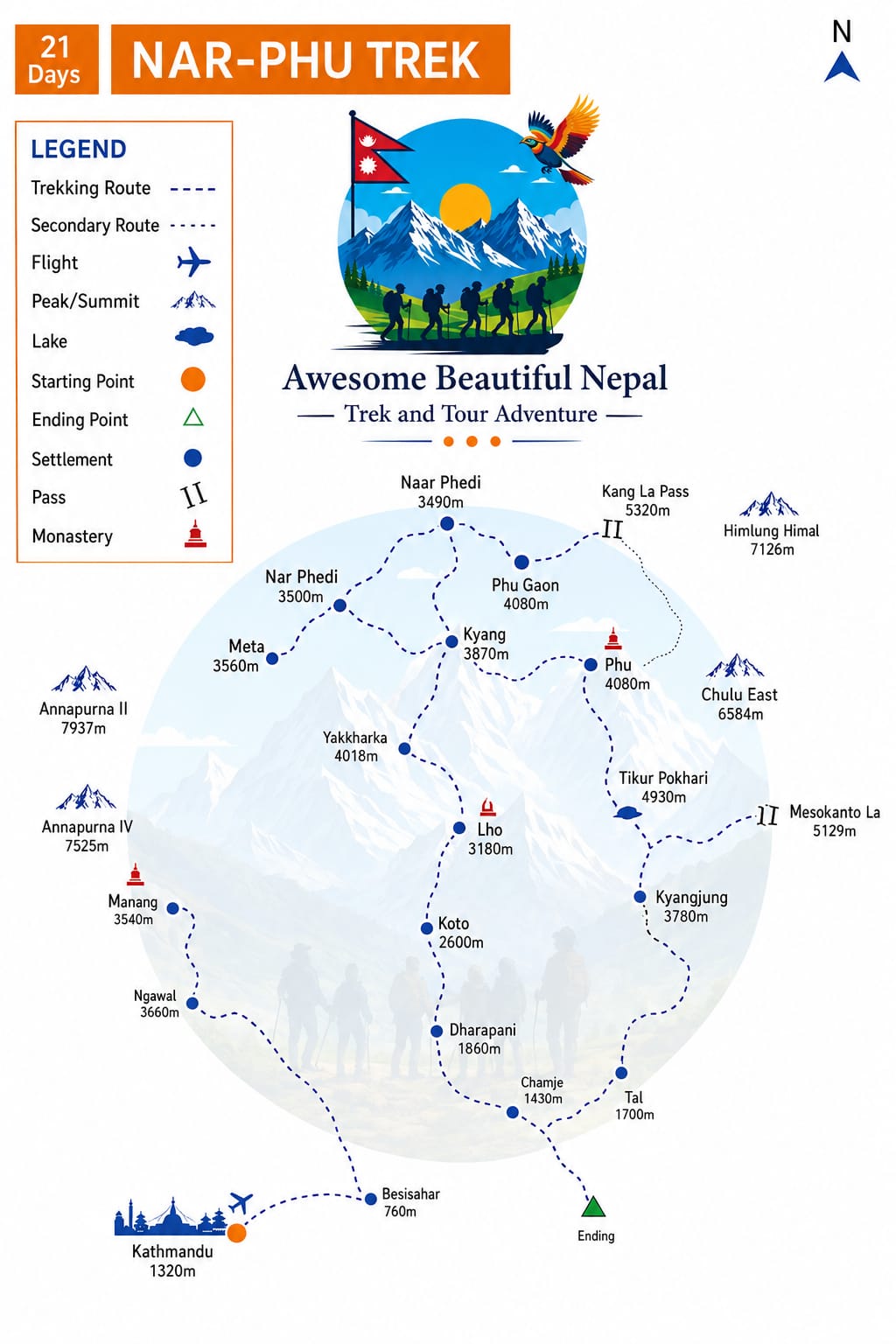
Map

Trip Inclusions

Private Transport: Airport transfers & all ground transportation
Accommodation: 4 nights in a 3-star hotel (Kathmandu) + 1 night in Pokhara with breakfast
Guided Kathmandu Tour: Private vehicle & expert guide
Trek Essentials: Best lodge-to-lodge stays, full board meals, & experienced guide/porter (with insurance)
Flights & Transfers: Jomsom–Pokhara airfare, private & shared road transport
Gear & Extras: Duffle bag, down jacket, sleeping bag, trekking map, & Nepal Adventure Guide T-shirt
Permits & Fees: Annapurna Conservation, Nar Phu Special Permit, TIMS
Safety & Support: First aid kit, trip certificate & all government taxes

  • Meals not specified in the 'Meal Inclusions' in the itinerary.'
  • Travel Insurance
  • International airfare
  • Nepal entry visa.
  • All kinds of drinks (hot and cold)
  • Hot showers during the trek
  • Personal trekking equipment
  • Tips for trekking staff and driver

Departure dates

Start Date
End Date
Price
Status

No available dates

Departure dates

No available dates

FAQs

The Nar Phu Trek is an off-the-beaten-path adventure in the Annapurna region, taking you through the remote Nar and Phu valleys, offering Tibetan-influenced culture, ancient monasteries, and stunning Himalayan landscapes.


It is a moderate to challenging trek due to high altitudes, rugged terrain, and long walking hours (5–7 hours daily). Previous trekking experience is recommended.

The best seasons are spring (March–May) and autumn (September–November) for clear skies and stable weather. Winter is extremely cold, and monsoon makes trails slippery.

Yes, you need: Annapurna Conservation Area Permit (ACAP) Nar Phu Special Restricted Area Permit TIMS (Trekkers' Information Management System) Card

You will stay in teahouses/lodges during the trek, offering basic but comfortable twin-sharing rooms with simple meals. In Kathmandu and Pokhara, you’ll stay in 3-star hotels.

You will get full board meals (breakfast, lunch, and dinner) with local and international options such as dal bhat, noodles, soups, and momos.

The highest point is Kang La Pass (5,322m), offering breathtaking panoramic views of the Annapurna range.

Yes, as the trek goes above 5,000m. Proper acclimatization, staying hydrated, and ascending gradually help minimize the risk.

Reviews

Leave a Review

Book Your Trip Now!

US $2000 x 1 guests: US $2000
Total US $2000
CUSTOMIZE

Similar Packages

image
Annapurna Region

Mardi Himal Trek

2 reviews

$500.00

9 Days Trip Details
image
Annapurna Region

Ghorepani Poonhill Trek

0 reviews

$450.00

8 Days Trip Details
image
Annapurna Region

Annapurna Base Camp Trek

0 reviews

$650.00

10 Days Trip Details